
Creating more content isn’t always the answer. A clear content strategy helps you understand what your audience is searching for, which topics are worth your attention and how each piece of content can support your wider search and business goals.
Without a clear plan, content can easily become a collection of pages and articles with no real connection between them.
A content strategy gives each piece a purpose by connecting what your audience needs with the topics your business should be known for.
A strong content strategy isn’t about filling a publishing calendar. It’s about creating the right content for the right reasons.
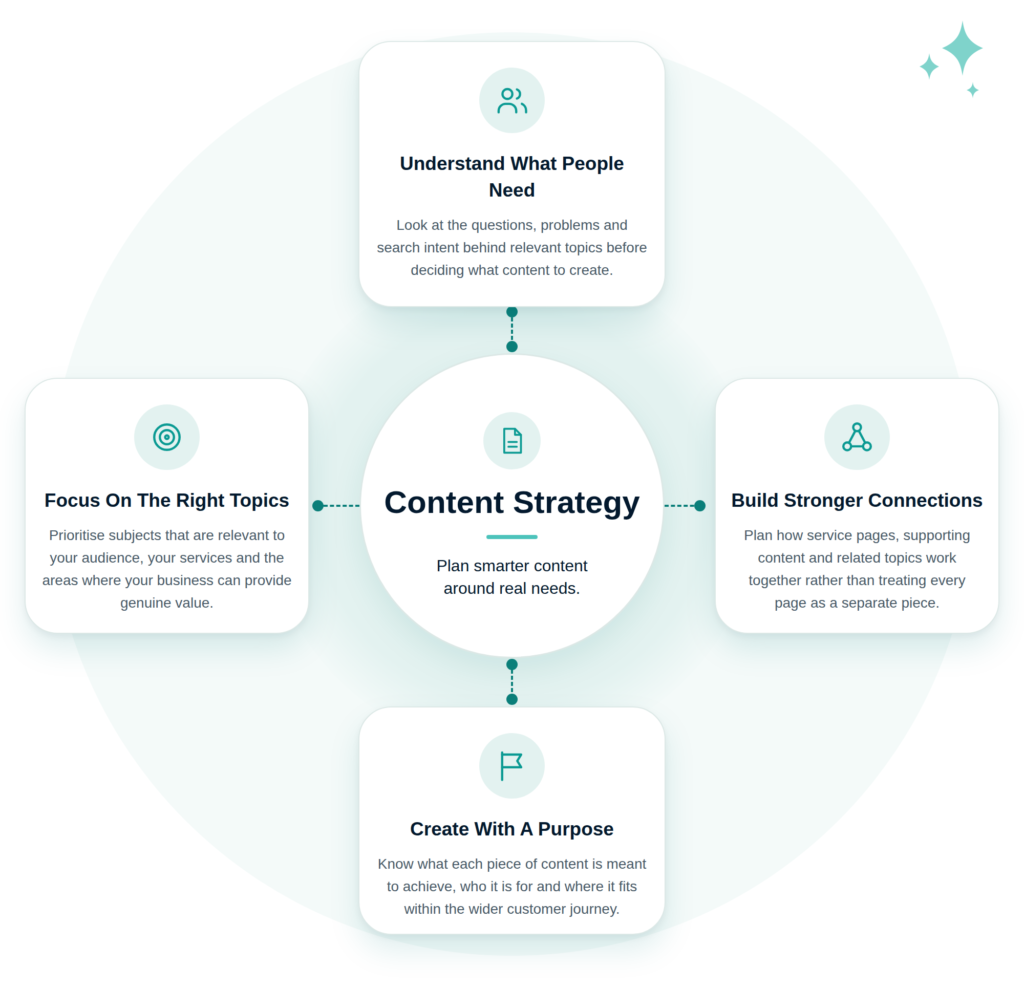
A useful content strategy brings research, audience needs and business priorities together. It gives you a clearer way to decide what to create, what to improve and how your content should work together over time.
Look beyond keywords to understand what people are actually trying to find, learn or decide when they search.
Identify important questions, topics and areas your existing website may not cover well enough.
Not every opportunity needs a new page. Existing content can often be updated, expanded or better connected before something new is created.
Plan content for different stages of discovery and decision-making so visitors can move naturally from useful information towards relevant services.
The goal isn’t to publish everywhere. It’s to build useful content around the topics that matter to your audience and your business.


Research The Opportunity
Review your audience, existing content, search behaviour and relevant competitors to understand where useful opportunities exist.
Build The Content Plan
Turn the research into clear topics, priorities and content formats based on what your website and audience actually need.
Create A Connected Content Structure
Organise new and existing content so important topics support each other and connect naturally with your services.
Content strategy is the process of deciding what content your business needs, who it should help and how it should support your wider search and business goals.
It brings research, planning and structure together before content is created or improved.
It starts with purpose.
Instead of choosing topics simply because they have search volume, content decisions consider audience needs, search intent, business relevance and the role each page should play.
New and existing content is organised around relevant topics and services, helping your website build clearer relationships between the information you provide and the work you do.
Audience & Search Insights
Understand what your audience is looking for, the questions they ask and the intent behind relevant searches.
Audience | Intent | Search Behaviour

Identify useful topics, content gaps and existing pages that may need to be created, updated or expanded.
Topics | Gaps | Existing Content
Plan how content should be organised and connected across your website.
Pages | Internal Links | Relationships

Bring the research and opportunities together into a practical plan showing what to create, what to improve and what to prioritise.
A content strategy gives your content a purpose before time and resources are spent creating it.
Every business has different audiences, services and content needs, so the strategy is built around what already exists and where the most useful opportunities are.
The aim is to create a practical content direction based on audience needs, search behaviour and the role content should play in your wider marketing and SEO strategy.
Review important pages and existing content to understand what's working, what's outdated and where improvements may be needed.
Understand what relevant audiences are searching for, why they're searching and the type of information that best matches their needs.
Identify useful topics, unanswered questions and gaps where your website could provide stronger or more complete information.
Connect relevant search themes with the right pages and topics so content decisions aren't based on isolated keywords.
Review relevant search competitors to understand the topics they cover, where they are gaining visibility and where useful opportunities may exist.
Plan how related pages and topics should connect so users and search engines can move naturally through your website.
Organise recommendations into a practical plan showing what should be created, improved or consolidated and where to focus first.
Plan content with both traditional search and evolving AI-driven discovery in mind, while keeping usefulness and relevance at the centre.
You don’t need a longer list of content ideas. You need a clear plan for what deserves to be created, improved or prioritised.
Understand what people are searching for, the questions they have and the information they need before deciding what deserves to be created.
Content opportunities are considered alongside your services, expertise and business priorities so the strategy stays commercially relevant.
Decide whether content should attract new visitors, answer an important question, support a service or strengthen an existing topic.
The strongest content opportunities sit where audience needs and business relevance come together.
A content strategy can help when you know content should play a bigger role in your marketing, but you’re not sure what to create, improve or prioritise next.
If you're creating content but aren't confident about what deserves your time and attention, a clear strategy can give you a better direction.
Blogs and pages are being published, but there isn't a clear strategy connecting them to your audience, services or wider goals.
You need a better way to find relevant content opportunities instead of relying on random ideas or repeating the same subjects.
Your website already has useful content, but some pages may be outdated, overlapping, underdeveloped or disconnected from the rest of the site.
You want content decisions to consider search demand without chasing keywords that have little relevance to your services or audience.
You're adding new services, entering new markets or expanding important topics and need a clearer structure before creating more pages.
I don’t start with a target number of blogs or a list of keywords that need pages.
I first look at what your business already has, what your audience actually needs and where content can add genuine value. From there, the strategy becomes much clearer.
The aim isn’t to keep your publishing calendar busy. It’s to make better decisions about the content your website actually needs.

Review your current content before recommending something new. Useful pages may need improving, combining or better positioning rather than replacing.
Search demand matters, but it isn't the only reason to create content. Relevance, intent, business value and usefulness all shape the decision.
Focus first on the topics and content gaps that make the most sense for your audience, website and business.
Create a roadmap that can realistically be implemented instead of an oversized content plan that looks impressive but never gets finished.
Content Strategy FAQs
A content strategy is a plan for deciding what content your business needs, who it should help and how it should support your wider business and search goals. It can cover new content as well as improvements to pages you already have.
No. Content writing is the creation of the content itself. Content strategy comes before and around that process, helping decide what should be created, improved or prioritised and how different pieces of content should work together.
Not necessarily. New content can be useful when there is a genuine gap or opportunity, but existing pages may also benefit from being updated, expanded, consolidated or better connected through internal links.
I consider search intent, audience needs, topic relevance, existing content, competitor insights and how closely an opportunity connects with your services and business goals. Search volume alone doesn't decide what is worth creating.
Yes. Useful, well-structured content can support visibility across traditional search and newer AI-driven discovery. The strategy still starts with creating clear, relevant content for real audience needs rather than writing specifically for an algorithm.
The exact output depends on your website and needs, but it can include content findings, topic opportunities, priorities, recommendations and a practical roadmap showing what should be created, improved or consolidated.
Build a practical content strategy around what your audience needs, what your business offers and where the right opportunities exist.